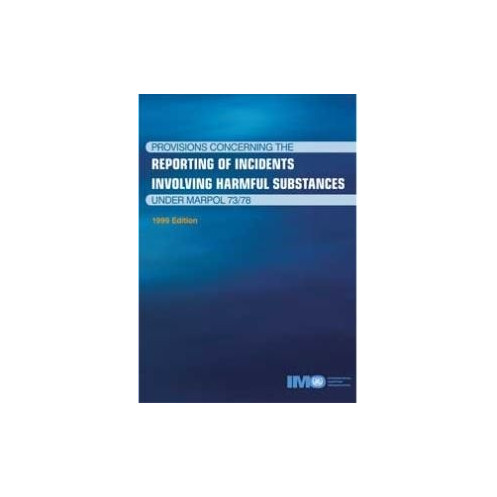





Access MARPOL’s incident reporting rules for harmful substances in this official digital guide. Features key provisions, reporting frameworks, and compliance tools for maritime professionals.
Data sheet
Specific References
Streamline Incident Reporting with MARPOL Compliance Guidelines
Ensure your maritime operations meet international environmental standards with this essential digital publication on incident reporting under MARPOL. Designed for shipping professionals, this document provides the regulatory backbone for reporting accidents involving harmful substances, helping prevent pollution and enhance safety at sea. With clear guidelines and standardized procedures, it simplifies compliance while supporting global maritime security efforts.
Regulatory Framework for Harmful Substance Incidents
This publication delivers the full text of Article 8 of MARPOL 73/78, alongside critical resolutions such as MEPC.21(22) and A.851(20). These documents establish the legal and operational requirements for reporting incidents, ensuring consistency across international waters. The inclusion of amendments to Protocol I further strengthens its relevance, making it a comprehensive resource for maritime compliance.
Practical Tools for Maritime Professionals
Beyond regulations, this document offers actionable guidance for incident reporting, including step-by-step procedures for notifying authorities. A directory of agencies and officials responsible for receiving reports ensures seamless communication, reducing response times during emergencies. Its 31-page format balances brevity with detail, making it an efficient reference for ship operators, port authorities, and environmental compliance officers.
Secure and Accessible Digital Format
Available as a digital publication, this resource is compatible with the free IMO Bookshelf reader, providing secure and convenient access for desktop users. While not supported on Mac, iOS, or Android, its locked format ensures the integrity of the content, making it a reliable tool for professionals in the shipping industry. The digital edition also aligns with modern maritime workflows, reducing reliance on physical documents.
This digital publication is presented in a secure, locked format compatible with the IMO Bookshelf reader. It spans 31 pages and is available in English, reflecting the 1999 edition of the original 1986 publication. The file format is .ebk, optimized for desktop use, with dimensions of 250 mm in height and 210 mm in width. Compatible readers include IMO ePublications, MS SeaReader, and Witherby Connect, ensuring broad accessibility for maritime professionals.
With decades of expertise in maritime regulation, this publisher is a leading authority in developing international standards for shipping safety and environmental protection. Their publications are trusted by maritime professionals worldwide, offering clear, actionable guidance to ensure compliance with global maritime laws. This digital resource reflects their commitment to accessible, reliable, and up-to-date regulatory content.
This publication includes MARPOL 73/78 Article 8, Resolution MEPC.21(22), amendments to MARPOL 73/78 Protocol I, and Resolution A.851(20). It also outlines general principles for ship reporting systems and reporting requirements.
The IMO Bookshelf software, available for free, is required to read this publication. It is not compatible with Mac, iPhone, iOS, or Android devices.
Yes, the publication includes guidelines for reporting incidents involving dangerous goods, harmful substances, and/or marine pollutants.
The digital publication has a height of 250 mm and a width of 210 mm when viewed in the compatible reader software.
No, it is only compatible with specific readers such as IMO ePublications, MS SeaReader, and Witherby Connect.
The publication contains 31 pages.
The publication includes a list of agencies or officials responsible for receiving and processing reports of incidents involving harmful substances.
You might also like