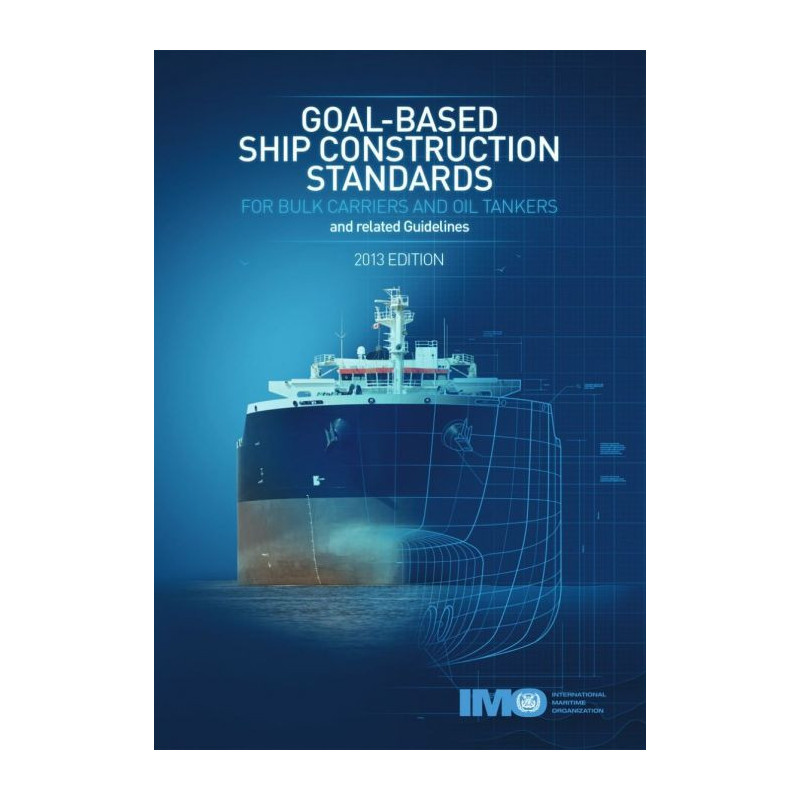





Digital guide to goal-based ship construction standards for bulk carriers and oil tankers. Covers SOLAS amendments, compliance verification, and documentation requirements for safe vessel design.
Data sheet
Specific References
This essential publication sets the benchmark for international ship construction, offering a goal-based approach that ensures safety, efficiency, and compliance in the maritime industry. Designed for naval architects, shipbuilders, and maritime regulators, it provides a structured methodology for constructing bulk carriers and oil tankers that meet the highest international standards. By focusing on performance-based objectives rather than prescriptive rules, this guide allows for innovation while maintaining rigorous safety and environmental protections.
The publication includes the internationally recognized Goal-Based Ship Construction Standards for Bulk Carriers and Oil Tankers (resolution MSC.287(87)), which have been made mandatory through amendments to the SOLAS Convention (MSC.290(87)). These standards establish clear, measurable goals for ship design and construction, ensuring that vessels are built to withstand operational stresses and environmental challenges. The guidelines also cover verification processes to confirm compliance, providing a robust framework for classification societies and regulatory bodies.
Beyond construction standards, this publication offers detailed directives for verifying compliance, including the Guidelines for Verification of Conformity to Goal-Based Ship Construction Standards (MSC.296(87)). It also outlines the essential information to be included in the Ship Construction File (MSC.1/Circ.1343), ensuring transparency and traceability throughout a vessel’s lifecycle. Additionally, the Generic Guidelines for Developing Goal-Based Standards (MSC.1/Circ.1394) provide a flexible yet structured approach for future regulatory developments, making this an indispensable resource for maritime professionals.
Available in a secure digital format, this publication is optimized for use with the free IMO e-reader, allowing instant access to critical standards and guidelines. The digital version ensures that maritime professionals worldwide can reference the latest construction requirements without delay, supporting efficient decision-making in ship design, construction, and regulatory compliance.
Transforming Ship Construction with Goal-Based Standards
The Goal-Based Ship Construction Standards for Bulk Carriers and Oil Tankers and Related Guidelines is a pivotal resource for the maritime industry, offering a forward-thinking approach to vessel design and safety. This digital publication consolidates the latest international regulations, including the mandatory SOLAS amendments (MSC.290(87)) and the Goal-Based Standards (MSC.287(87)), into a single, accessible framework. By shifting from prescriptive rules to performance-based objectives, it empowers shipbuilders, naval architects, and regulators to innovate while ensuring compliance with the highest safety and environmental standards.
Key Regulatory Framework for Bulk Carriers and Oil Tankers
At the core of this publication are the Goal-Based Ship Construction Standards, which define clear, measurable objectives for the structural integrity, operational safety, and environmental performance of bulk carriers and oil tankers. These standards are supported by verification guidelines (MSC.296(87)) to ensure consistent application across the industry. The inclusion of SOLAS amendments makes these standards legally binding, reinforcing their critical role in global maritime safety. The publication also provides directives for compiling the Ship Construction File (MSC.1/Circ.1343), a comprehensive record of design and construction details that enhances transparency and accountability.
Flexible and Future-Ready Guidelines
Beyond specific standards, this publication includes the Generic Guidelines for Developing Goal-Based Standards (MSC.1/Circ.1394), offering a adaptable methodology for future regulatory developments. This ensures that the maritime industry can evolve in response to technological advancements and emerging challenges while maintaining a consistent approach to safety and compliance. The digital format, compatible with the IMO’s free e-reader, provides immediate access to these critical resources, making it an indispensable tool for professionals involved in ship design, construction, and regulation.
This digital publication is presented in English and is optimized for use with the IMO’s free e-reader. Published in 2013 by the International Maritime Organization (IMO), it is a secure, non-printable e-book with dimensions of 11.70 x 8.25 x 0.50 inches and a digital file size equivalent to 0.80 lb.
The International Maritime Organization (IMO) is the United Nations’ specialized agency responsible for regulating international shipping. Established in 1948, the IMO sets global standards for maritime safety, security, and environmental performance, ensuring that shipping remains the most efficient and sustainable mode of global transport. Its publications, including this digital guide, are recognized as the definitive reference for maritime professionals worldwide.
This publication includes resolutions MSC.287(87) for goal-based ship construction standards, MSC.290(87) for SOLAS amendments, MSC.296(87) for compliance verification guidelines, MSC.1/Circ.1343 for Ship Construction File details, and MSC.1/Circ.1394 for generic goal-based standards development.
No, the digital version is locked and can only be read using the free IMO e-reader software.
The standards and guidelines in this publication apply specifically to bulk carriers and oil tankers.
Yes, the SOLAS amendments (MSC.290(87)) included in this publication make the goal-based construction standards mandatory for bulk carriers and oil tankers.
This edition was published in 2013.
The printed version measures 11.70 inches in depth, 8.25 inches in height, and 0.50 inches in width.
You might also like