



Data sheet
Specific References
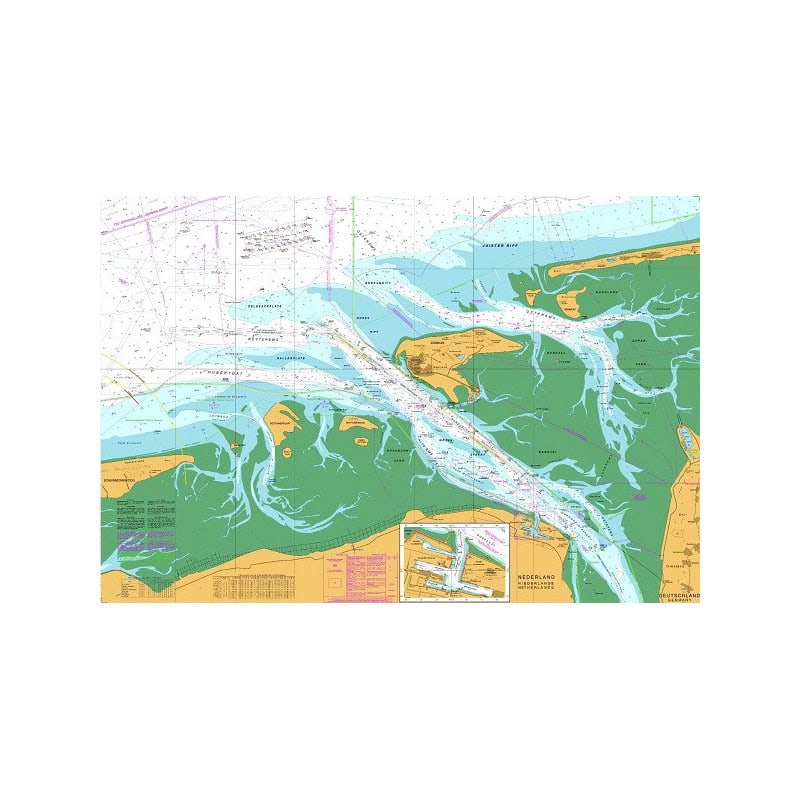
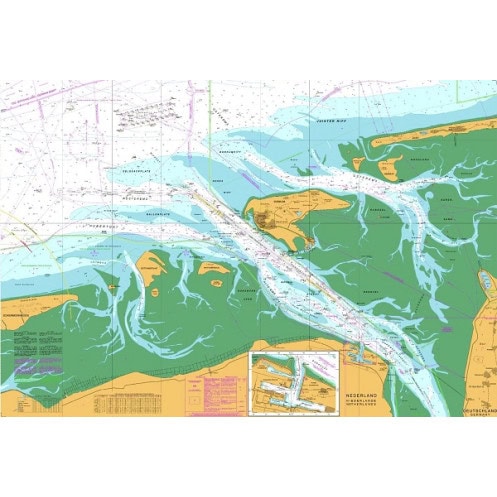
Nautical charts produced by the Hydrographic Service of the Royal Netherlands Navy cover Dutch waters, including the North Sea, the Dutch coastline, major estuaries (Scheldt, Meuse, Rhine), and the highly complex Wadden Sea area.
Navigating in this region means operating in a dynamic and technically demanding environment: shallow waters, shifting sandbanks, strong tidal influences, dense maritime traffic, and major port infrastructures (with Rotterdam being one of the largest ports in the world).
These charts are designed for all types of mariners—recreational sailors, coastal navigators, and professionals—who require precision and anticipation. In Dutch waters, choosing the right chart is a direct safety requirement.
Dutch Hydrographic Office charts are designed to support real navigation scenarios, often in technically complex conditions.
The Dutch coastline is characterized by shifting sandbanks and buoyed channels. These charts help navigators follow safe routes and avoid hazardous shallow areas.
The Rhine–Meuse–Scheldt delta requires precise understanding of currents, depths, and buoyage. Charts provide essential clarity in these complex waterways.
Traffic Separation Schemes (TSS) and major shipping routes are clearly marked, allowing safe navigation in heavily trafficked zones.
Recreational users benefit from accurate information on anchorages, port access, and navigable zones.
Compared to digital-only solutions, paper charts provide a comprehensive overview that is essential in constantly evolving environments.
Within a learning framework, these charts help develop an understanding of tidal navigation and complex coastal systems.
Autonomous skippers and coastal navigators rely on these charts for route planning and hazard anticipation.
Shipping, fishing, and pilotage operations depend on the accuracy of these charts in economically critical waters.
With detailed buoyage and light information, these charts are suitable for all visibility conditions.
They complement GPS, chartplotters, and ECDIS by providing a broader strategic overview.
The goal is to help each navigator clearly assess how these charts fit their real navigation needs.
Charts are available at different scales:
In Dutch waters, large-scale charts are often essential due to the complexity of seabed conditions.
Careful chart reading is essential in an environment where seabed conditions change rapidly.
Charts are produced by the Hydrographic Service of the Royal Netherlands Navy, ensuring high accuracy.
Sandbanks and channels change regularly. Corrections are issued through Notices to Mariners.
Using a recent chart is critical. Outdated charts can quickly become unreliable in this region.
Charts are aligned with international standards such as WGS 84, ensuring accurate GPS positioning.
Safety depends on combining reliable charts with disciplined navigation practices.
Electronic systems provide:
However, they do not replace the strategic overview of a paper chart.
In Dutch waters, combining both formats is a fundamental safety principle.
A combination of charts is recommended: general charts for offshore navigation and detailed charts for coastal and port areas.
No. It should be used alongside GPS, tidal data, sailing directions, and real-time observation.
Whenever a new edition is released or significant updates occur.
Yes. These charts are compatible with modern GPS systems using the WGS 84 reference.
Each hydrographic office covers its own region. Dutch charts are the official reference for the Netherlands.
They provide a global overview and a reliable backup in case of electronic system failure.
Dutch Hydrographic Office nautical charts are essential tools for navigating the complex and dynamic waters of the Netherlands. Their accuracy, level of detail, and reliability make them indispensable for both recreational and professional navigation.
Choosing the right chart—up-to-date and properly used—ensures safer, more efficient, and better-controlled navigation. Nautic Way supports this approach by offering a carefully curated selection tailored to the needs of demanding sailors.
Dutch Hydrographic Office nautical charts are updated daily and printed only on demand. On the day of printing, they incorporate the latest updates. The chart's publication year is indicated on it.
We strive to offer only the latest versions of nautical charts incorporating the most recent updates.
All nautical charts, whether paper or digital, are printed on demand and include the latest updates. In accordance with Article L221-28 of the French Consumer Code, the right of withdrawal cannot be exercised for goods liable to become obsolete rapidly. Paper charts and digital charts are neither returnable nor exchangeable. Consequently, these orders are final upon placement by the Customer, according to the terms and conditions specified in these General Terms and Conditions of Sale.
You might also like