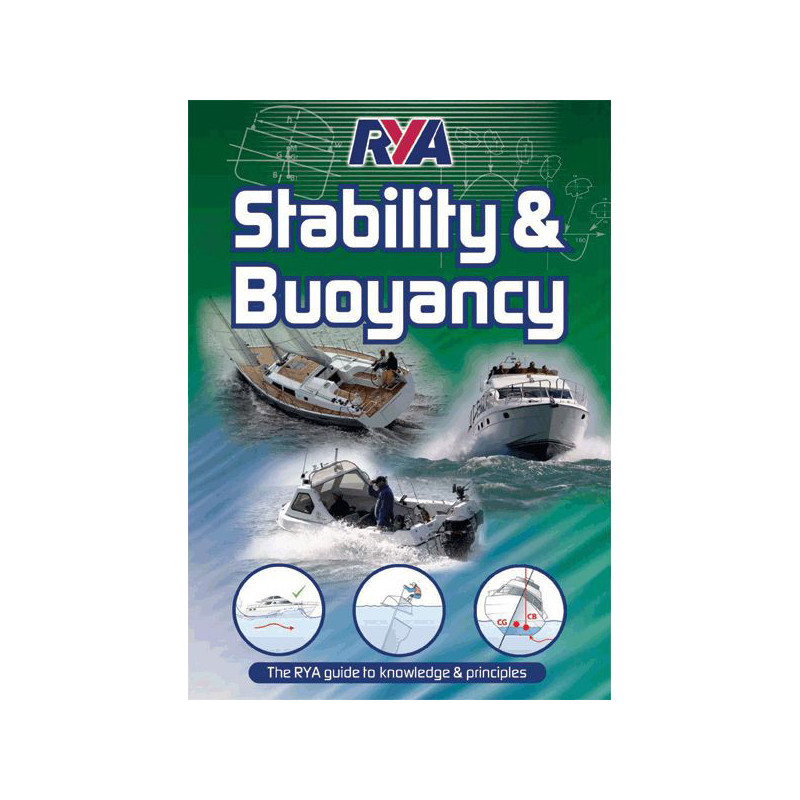




This expert guide on stability and buoyancy covers critical risks like improper loading, breaking waves, and resonant rolling. Ideal for instructors and Yachtmaster candidates.
Data sheet
Specific References
Every vessel, from a small dinghy to a large offshore yacht, relies on two fundamental principles: stability and buoyancy. Without them, even the most advanced boat can become a hazard. This comprehensive guide demystifies the critical concepts that keep your vessel afloat and upright, ensuring safer and more confident sailing. Whether you're an instructor, a coded vessel operator, or a Yachtmaster candidate, this book provides the clarity and expertise you need to navigate these essential topics with precision.
Stability and buoyancy aren’t just theoretical concepts—they’re the backbone of safe seamanship. This guide breaks down complex principles into practical, actionable knowledge, covering everything from the dangers of improper loading to the risks of resonant rolling and broaching in following seas. Learn how different boat types—sailing dinghies, small catamarans, and offshore monohulls—behave under varying conditions, and discover how to assess the maximum safe heeling angle for your vessel. With clear explanations and real-world scenarios, this book bridges the gap between classroom learning and on-the-water decision-making.
For sailing instructors, this guide serves as an invaluable teaching tool, offering a structured approach to explaining stability and buoyancy in a way that’s easy to understand. Coded vessel operators will find it an essential reference for maintaining compliance and safety standards, while Yachtmaster candidates will benefit from its in-depth coverage of key topics like the Angle of Vanishing Stability (AVS). Packed with expert advice and a glossary of technical terms, it’s the definitive resource for anyone serious about mastering the forces that govern their boat’s performance.
Printed on paper sourced from sustainable forests, this guide is as environmentally responsible as it is informative. Its compact, lightweight format makes it easy to carry onboard or reference in the classroom, ensuring that critical knowledge is always within reach. Whether you're preparing for an exam, teaching a course, or simply looking to deepen your understanding of boat dynamics, this book delivers the insights you need to sail smarter and safer.
Unlock the Secrets of Safe and Stable Sailing
Stability and buoyancy are the unsung heroes of seamanship—without them, even the most well-designed boat can become a liability. This essential guide, now in its updated edition, is your key to understanding the forces that keep your vessel afloat and upright in any condition. Designed for sailors, instructors, and maritime professionals, it transforms complex naval architecture principles into clear, practical knowledge that can be applied on the water. Whether you're navigating rough seas or teaching the next generation of sailors, this book provides the expertise you need to make informed, safety-critical decisions.
From Classroom Theory to On-the-Water Confidence
This guide doesn’t just explain the science—it shows you how to use it. Dive into the dangers of improper loading, the risks of resonant rolling, and the perils of broaching in following seas, with real-world examples that bring theory to life. Learn how different boat types—from small sailing dinghies to offshore monohulls—respond to varying conditions, and discover how to determine the maximum safe heeling angle for your vessel. With a glossary of technical terms and expert insights, it’s the perfect resource for anyone looking to deepen their understanding of boat dynamics and enhance their sailing skills.
Built for Instructors, Skippers, and Safety-Conscious Sailors
For sailing instructors, this book is an indispensable teaching aid, offering a structured and accessible way to explain stability and buoyancy to students. Coded vessel operators will find it a vital reference for maintaining safety standards, while Yachtmaster candidates will appreciate its clear explanations of critical concepts like the Angle of Vanishing Stability (AVS). Lightweight, portable, and printed on sustainable paper, it’s designed to be your go-to resource whether you're in the classroom, on the dock, or out at sea.
This 40-page paperback guide is packed with expert knowledge, presented in a compact and easy-to-reference format. Measuring 148 mm in width and 210 mm in height, it’s lightweight at just 120 grams, making it ideal for carrying onboard or using in the classroom. Printed on sustainably sourced paper, this 2009 edition has been reprinted in 2024 to ensure the latest insights are available to sailors and instructors alike. Written by maritime experts Jeremy Evans, Pat Manley, and Barrie Smith, it’s a trusted resource for anyone serious about safe and stable sailing.
With a legacy of excellence in maritime education, this publisher is a trusted name among sailors, instructors, and maritime professionals worldwide. Known for producing high-quality, practical guides, their resources are designed to bridge the gap between theory and real-world application, ensuring that sailors of all levels can navigate with confidence and skill.
The book covers the maximum safe heeling angle, also known as the angle of vanishing stability (AVS), and explains its importance for different types of vessels.
Yes, it details resonant rolling, its causes, and the potential dangers it poses to various types of boats.
The book provides a clear explanation of stability and buoyancy concepts, including AVS, making it a useful resource for Yachtmaster candidates.
It includes information on sailing dinghies, small catamarans, offshore and coastal monohull sailboats, and other vessel types.
The book contains 40 pages of technical content on stability and buoyancy principles.
Yes, it is printed on paper sourced from sustainable forests.
The most recent reprint of this edition was in 2024.
You might also like