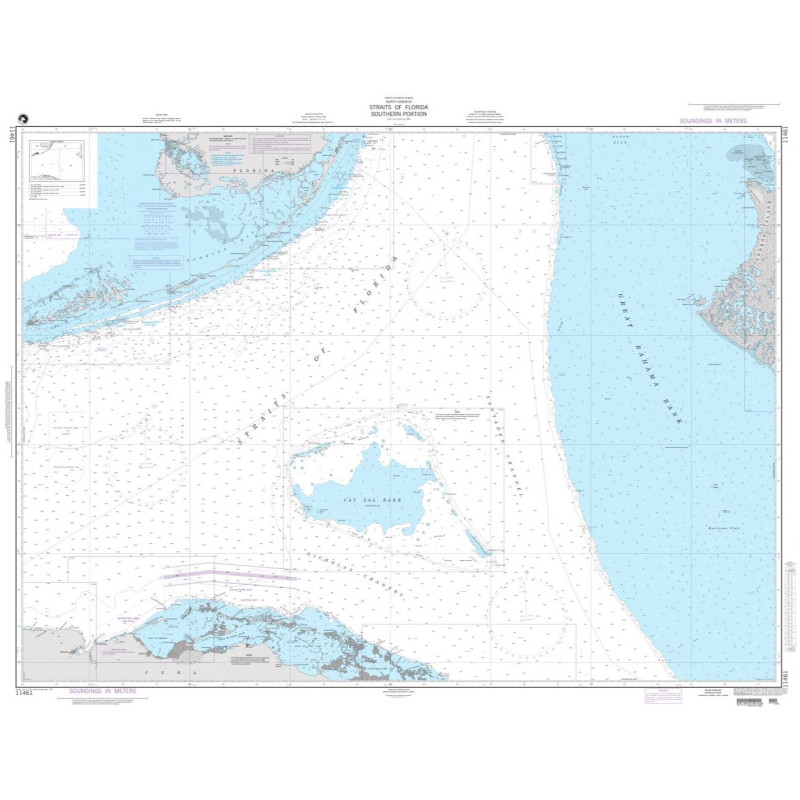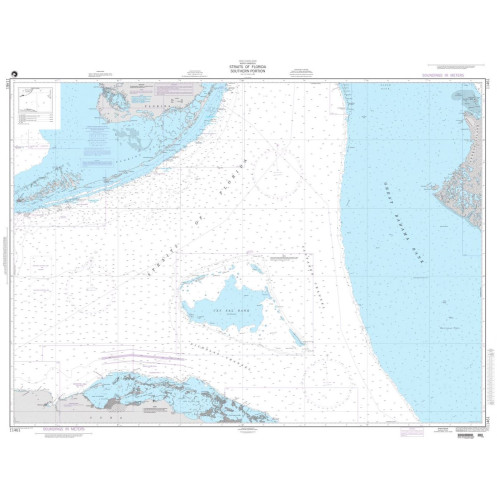


NGA - 11461 - nautical chart - Straits of Florida-Southern Portion
search
  • googlemap
  • NGA - 11461 - nautical chart - Straits of Florida-Southern Portion

Nautical chart NGA - 11461 - Straits of Florida-Southern Portion

€64.45
NGA - National Geospatial Intelligence Agency
In English language Rolled paper chart
chart printed to order
Estimated preparation time: 8 to 20 days
NGA publishes US nautical charts in international waters
nga-11461

Data sheet

Year
chart printed to order incorporating the latest corrections
Author
NGA - National Geospatial Intelligence Agency
Scale
1:300.000
Picto
In English language
Rolled paper chart
Classification scale paper chart
Coastals
Paper chart format
Flat chart (rolled in a tube)
Support
paper version
Navigation area
Atlantic Ocean
Gulf of Mexico
Chart type
Navigation chart

Specific References

UPC
400000158402
EAN13
4000000153047
New
chart printed to order
Description détaillée

This National Geospatial Intelligence Agency paper navigation chart (flat chart) covers Atlantic Ocean, Gulf of Mexico, the area Straits of Florida - Southern Portion.

NGA nautical charts, produced by the National Geospatial Intelligence Agency, are designed to support international and offshore navigation. They provide broad coverage of the world’s oceans, particularly in areas where national hydrographic charts may be limited or less accessible.

Available from the Nautic Way online maritime bookstore, NGA charts are intended for navigators who need a global, consistent, and reliable overview of major sea routes, whether for long-distance passages, vessel deliveries, or strategic route planning.

Choosing an NGA chart means equipping yourself with a tool designed to anticipate, plan, and secure large-scale navigation across open waters.

Important: NGA has not updated its paper nautical charts for several years. Upon purchase, you will need to update your chart using the notices to mariners.

What is an NGA nautical chart used for?

NGA charts are primarily planning and offshore navigation charts, used in an international context.

Practical uses

They are particularly suited for:

  • Ocean and offshore navigation
  • International route planning
  • Long-distance crossings
  • Navigating in areas with limited national chart coverage
  • Following major shipping routes
  • The unit of measurement is the meter, the foot or the fathom; this unit is clearly specified on the maps.

Real-life navigation scenarios

  • Preparing a transoceanic passage

  • Sailing between continents
  • Delivering vessels over long distances
  • Anticipating high-traffic maritime zones

Added value compared to generic or digital-only charts

NGA charts provide:

  • Extensive global coverage
  • Consistent cartographic presentation worldwide
  • A strategic overview essential for offshore navigation

They help structure navigation before transitioning to detailed coastal charts.

Who are NGA charts recommended for?

NGA charts are primarily intended for navigators engaged in long-distance or complex offshore sailing.

Target users

  • Experienced offshore sailors
  • Skippers and delivery crews
  • Maritime professionals
  • Recreational sailors preparing long ocean passages

Navigation conditions

  • Designed for open sea navigation
  • Suitable for day and night sailing
  • Used alongside GPS, chartplotters, or ECDIS systems

They provide a strategic global perspective, essential at sea.

How to read and use an NGA nautical chart

NGA charts are structured for clarity at large scales.

Understanding chart scale

  • Small scales dominate: ocean-wide overview
  • Intermediate scales: transition zones toward coastal navigation

These charts are not intended to replace detailed coastal charts but to support effective route planning.

Key information displayed

An NGA chart includes:

  • General depth information
  • Major shipping routes
  • Traffic zones
  • Significant isolated dangers
  • Certain regulated or special areas

Essential user knowledge

  • Use NGA charts for planning, not detailed harbor approaches
  • Complement them with local charts for coastal navigation
  • Interpret data at a strategic, large-scale level

NGA charts are planning and anticipation tools, not fine navigation charts.

Reliability, updates, and safety

A structured update system

The NGA provides:

  • Notices to Mariners
  • Regular chart corrections

Standards and compatibility

  • Based on the WGS 84 geodetic system
  • Fully compatible with GPS
  • Aligned with international hydrographic standards

Best safety practices

  • Always verify the chart edition date
  • Complement with up-to-date local charts
  • Use multiple sources for navigation decisions

Safe navigation relies on combining reliable and up-to-date data sources.

Paper vs digital NGA charts – why keep paper onboard?

Advantages of paper charts

  • Immediate global route overview
  • Effective strategic planning tool
  • No dependence on electronic systems
  • Reliable backup in case of equipment failure

Complementarity with electronic tools

  • Supporting route planning
  • Cross-checking GPS positions
  • Ensuring redundancy in navigation systems

In offshore navigation, redundancy is essential for safety.

FAQ – NGA nautical charts

Which NGA chart should I choose for an ocean crossing?
Select a chart covering your overall route, then complement it with detailed coastal charts for departure and arrival areas.

Is an NGA chart sufficient on its own?
No, it must be complemented with detailed local charts for coastal navigation.

How often should NGA charts be updated?
Whenever a new edition is released or significant corrections are issued.

Are NGA charts compatible with GPS?
Yes, they are based on the WGS 84 system.

What is the difference between NGA and SHOM or Admiralty charts?
NGA charts are designed for global navigation planning, while SHOM or Admiralty charts generally provide more detailed coastal information.

Summary – NGA charts: a global perspective for offshore navigation

NGA nautical charts are essential tools for offshore navigation and international route planning. They provide a strategic global overview, crucial for anticipating long-distance passages.

By choosing them from Nautic Way, you benefit from expert selection, reliable cartography, and professional guidance, ensuring safe and confident navigation across the world’s oceans.

National Geospatial Intelligence Agency nautical charts are no longer maintained; they are printed on demand, and you are responsible for integrating any updates. The chart's publication year is indicated on it.

All nautical charts, whether paper or digital, are printed on demand. In accordance with Article L221-28 of the French Consumer Code, the right of withdrawal cannot be exercised for goods liable to become obsolete rapidly. Paper charts and digital charts are neither returnable nor exchangeable. Consequently, these orders are final upon placement by the Customer, according to the terms and conditions specified in these General Terms and Conditions of Sale.

Loading...