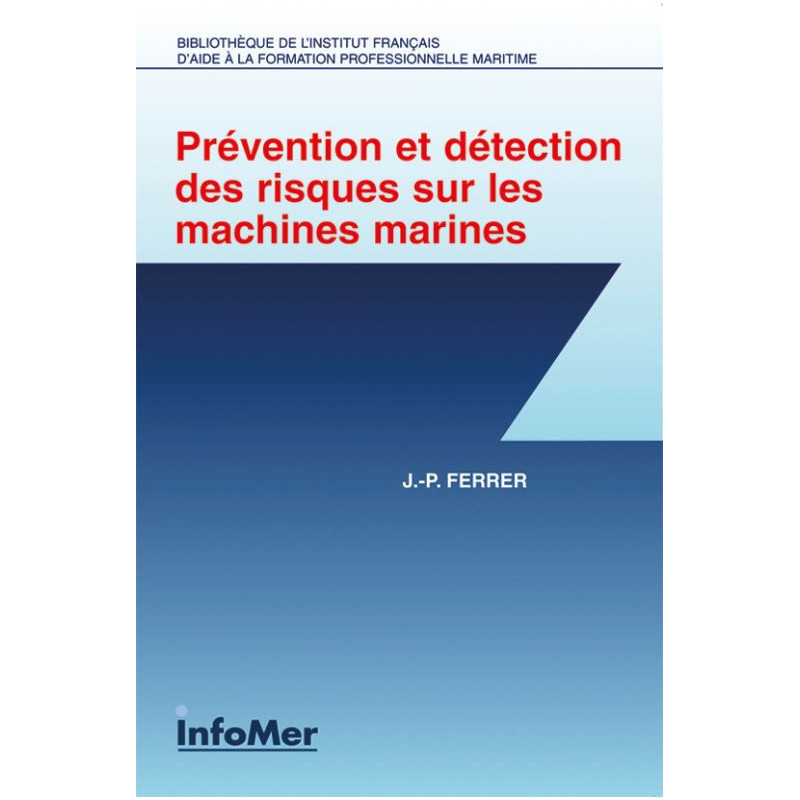



Prevent and detect risks in marine engines with this expert guide. Covers troubleshooting, propulsion failures, and maintenance for commercial and leisure vessels.
Essential for maritime professionals.
Data sheet
Specific References
Enhance Maritime Safety with Expert Guidance on Marine Machinery Risks
Marine Machinery Risk Prevention and Detection is a must-have resource for maritime professionals seeking to safeguard their vessels and crews. This technical guide provides an in-depth exploration of risk prevention and detection in marine engines, covering everything from theoretical foundations to practical troubleshooting. Designed for commercial, fishing, and recreational maritime sectors, it equips readers with the knowledge to identify, analyze, and mitigate risks effectively.
Comprehensive Coverage for All Engine Types
This book offers a thorough examination of marine engines, including both high- and low-power systems. It addresses critical components such as diesel engines (2-stroke and 4-stroke), turbochargers, pumps, boilers, refrigeration units, and winches. With a focus on real-world applications, it provides actionable insights for maintaining optimal performance and preventing costly breakdowns.
Structured Approach to Troubleshooting and Maintenance
Organized into four distinct yet complementary sections, this guide ensures a logical and practical learning experience. The first section introduces essential theoretical concepts, while the second section presents a tree-based analysis method for diagnosing engine anomalies. The third section tackles propulsion chain failures, offering solutions to maintain maneuverability, and the final section highlights maintenance operations with illustrative examples. This structured approach makes it an invaluable tool for both training and on-the-job reference.
Designed for Professionals and Students Alike
Whether you're a seasoned maritime professional or a student entering the field, this book is tailored to meet your needs. It supports initial training and continuous professional development, ensuring that readers stay ahead of industry challenges. With 420 pages of detailed content, it serves as a reliable companion for anyone responsible for marine engine safety and efficiency.
This technical guide, published in 2015, is a paperback edition with 420 pages of in-depth content. Written by marine engineering expert J. P. Ferrer, it is entirely in French and weighs 739 grams. The book measures 16 x 24 x 1.5 cm, making it a compact yet comprehensive resource for professionals in the maritime industry.
With decades of experience in maritime education and training, this publisher is a trusted name in the industry. Specializing in technical resources for maritime professionals, their publications are designed to support both initial training and continuous professional development, ensuring that readers have access to the latest industry knowledge and best practices.
The guide covers both high and low-power marine engines, including 2-stroke and 4-stroke diesels, turbos, pumps, boilers, and refrigeration systems.
Yes, it includes simple theoretical concepts as a prerequisite, making it accessible for initial training while also serving professionals for continuous learning.
Yes, it includes a tree-based analysis method to identify and diagnose engine defects and anomalies.
Yes, it covers failures from the engine to the propeller and rudder, with solutions to maintain maneuverability.
It includes illustrated examples of engine maintenance operations, covering systems like winches, boilers, and cooling systems.
The second edition contains 420 pages.
Yes, the book is structured into four independent sections: theoretical concepts, engine anomalies, propulsion chain failures, and maintenance operations.
You might also like