Fishing is associated with both sport and the pleasure of sea hunting. It can be practiced in several ways: from the shore, while sailing with your boat, or even through freediving spearfishing.
It’s also a way to stock up the fridge or freezer on your boat or at home. Here are some books on sea fishing to guide you. And for those sailing around the world, you might also want to bring along cookbooks and recipe ideas on board.
We also recommend checking out our article on provisioning for a round-the-world voyage by sailboat.
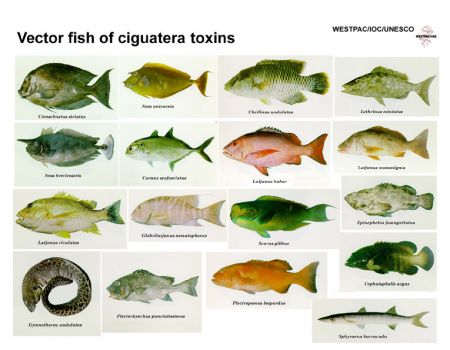
But be careful—a great fishing trip can end in serious food poisoning: watch out for ciguatera! Here are some books to help you identify fish.
Thanks to the crew of Sailing La Vagabonde for this video.
Ciguatera or Ichthyosarcotoxism (from the Greek ichtyos: fish, sarcos: flesh, toxicon: poison), also called “gratte” (popular name in New Caledonia), is a food poisoning linked to the ingestion of fish contaminated by the benthic microalga Gambierdiscus toxicus found in coral reefs.
Like many natural and artificial toxins, ciguatoxin accumulates in organisms and its concentration increases higher up the food chain, according to the principle of biomagnification. Among the 400 potentially infected species, large predatory fish such as barracuda, moray eel, grouper, or trevallies are the most likely to cause poisoning. The term ciguatera also refers to the phenomenon at its origin: the destruction of coral reefs.
History of Ciguatera
Ciguatera has been known for a very long time, with the first historical description attributed to a Chinese physician of the Tang dynasty, Chen Tsang Chi, around the year 650. From the 15th century onward, advances in navigation allowed the great explorers of the time to venture to unknown lands, where they discovered ciguatera at their own expense. Columbus, Magellan, Cortés, and Vasco da Gama described it in the Caribbean; Fernandes de Quiros, Cook, and Bligh reported it in the Pacific.
James Cook made the first precise description of ciguatoxin poisoning on September 7, 1774, in the New Hebrides:
"This afternoon, one of the natives having speared a fish, my secretary bought it and sent it to me after my return. It was a new species, somewhat like a sunfish, with a large long and hideous head. Suspecting nothing of its poisonous nature, we ordered it to be prepared for supper. But fortunately, so much time was spent drawing and describing it that it was too late to have it cooked, so only the liver and kidneys were prepared, of which Mr. Forster and I merely tasted a little. Around three in the morning, we found ourselves struck with an extraordinary weakness and numbness of all the limbs. I had almost lost the sense of touch and could not distinguish, among the things I was still able to lift, the heavy from the light. A quart of water and a feather weighed the same in my hand. We both took emetics and afterwards sweated profusely, which brought us much relief. In the morning, one of the pigs that had eaten the entrails was found dead."
The word ciguatera was later introduced by Cuban naturalist Felipe Poey in 1866 to describe a neuro-digestive intoxication caused by ingestion of a marine gastropod (Livona pica), commonly called cigua in Cuba.
Epidemiology of Ciguatera
Ciguatera affects about 400 million people living in endemic areas, with an estimated 50,000 cases of poisoning each year. It is the most widespread seafood-borne poisoning, alongside histamine poisoning. However, reported cases are likely underestimated: the diagnosis is difficult, healthcare access in endemic regions is limited, traditional medicine is often used, and information collection is challenging.
Its geographic distribution extends between the 35th parallel north and the 35th parallel south, in a circumtropical belt encompassing all coral reef regions (Pacific, Caribbean and West Indies, Indian Ocean). Its incidence increases as latitude decreases. Several French overseas territories are affected: Réunion (7.8/100,000), Guadeloupe (30/100,000), Martinique (41/100,000), New Caledonia (100/100,000), French Polynesia (500/100,000). Metropolitan France and non-endemic regions can also experience cases of ciguatera, mostly imported from coral reef areas or linked to the consumption of tropical fish served in restaurants.
Due to climate change, more cases are now recorded in Europe, particularly in Germany, where since 2012 nearly 20 patients with ciguatera are diagnosed each year.
Origin of Ciguatera
Corals are hermatypic animals, reef-building members of the order Scleractinia, presenting in multiple forms: encrusting, massive, columnar, branching, foliose, etc. Polyps, the living part of these organisms, inhabit the calcareous cups they build thanks to their symbiotic relationship with photosynthetic microalgae called zooxanthellae. Under stress, the polyps expel their symbionts, creating the “coral flowering” phenomenon. Prolonged stress leads to coral death through loss of their energy source, resulting in “coral bleaching” (the pigment of the zooxanthellae is what gives corals their color).
The stress can be natural (tidal waves, tsunamis, storms, cyclones, undersea earthquakes, freshwater influx, Acanthaster planci outbreaks…) or human-induced (coastal development using coral as building material, sediment plumes blocking sunlight, lagoon pollution, overfishing, irresponsible tourism, military activities, etc.). Large-scale factors such as global warming, which raises sea temperatures (corals suffer at 29°C and die above 30°C), and UV overexposure due to ozone depletion, also contribute to reef destruction.
These newly degraded coral surfaces are gradually colonized by algal turfs formed by macroalgae, which in turn host proliferating microalgae. Among them are dinoflagellates of the genus Gambierdiscus. In the Pacific, six species are known: G. toxicus, G. belizeanus, G. australes, G. pacificus, G. polynesiensis, G. yasumotoi; only G. toxicus causes ciguatera. Its optimal growth depends on water temperature (26–29°C), salinity (≈35 ‰), light intensity (2,000–3,000 lux with a 12-hour photoperiod), pH (8.2–8.4), and the presence of nutrients (silicates, tellurium oxides, algal debris) and vitamins (B12, biotin, thiamine). Any deviation slows its division rate. Microbial factors may also influence dinoflagellate growth, either as intermediaries in metabolizing substances from macroalgae or by enriching the environment with CO₂.
The time between coral disturbance and the first cases of ciguatera is estimated at about 20 months: 2–3 months for algal turfs to cover bare coral, 4 months before the first dinoflagellates appear, 8–9 months to reach significant density, and at least 3 more months before the first human poisonings are reported. In total, about 1.5–2 years. Without maintenance of the phenomenon, outbreaks last 10–30 years.
Ciguatoxin
Ciguatoxin is a liposoluble polyether, heat-stable, of low molecular weight, and considered one of the most powerful marine biotoxins—barely one microgram is enough to kill a human. Purification and detection techniques by chromatography have isolated 39 different ciguatoxins. They vary depending on geographic origin, fish species, and position in the food chain. Not all of their molecular structures have been identified. The reference toxin, the first discovered and most studied, is P-CTX1B, used as a standard in laboratory detection tests.
Ciguatoxins enter the food chain via coral-grazing fish and herbivores feeding on algae colonized by Gambierdiscus toxicus. These fish are then preyed upon by omnivores and carnivores. The toxins accumulate along the food chain, so carnivorous fish contain higher toxin levels than herbivores. Moreover, within fish, toxins undergo oxidative metabolism, making them even more toxic: carnivore-derived ciguatoxins are more harmful than those in herbivores.
Because CTXs are liposoluble, they accumulate preferentially in organs such as the liver, head, and gonads; they are also present in muscle tissue but at lower concentrations. In the Javanese moray eel (Gymnothorax javanicus), the ratio of toxin concentration between viscera and muscle is 50–100. The toxins seem to have little effect on the fish themselves; accumulation is slow, as are detoxification processes. Thus, older and larger fish present the greatest risk.
All reef-associated fish are potentially ciguatoxic, with more than 400 species reported, spanning 57 families and 11 orders. However, some appear exempt, such as pelagic fish that live and hunt only in the open sea (tunas, swordfish, marlins, mahimahi) or deep-sea fish. Nevertheless, isolated cases have been described after their consumption, suggesting possible secondary food chains.
Humans are poisoned when consuming these fish, with symptoms depending on toxin concentration—for example, 0.1 μg for P-CTX1B.
Summary
- Destruction of coral colonies. Colonization of their skeleton by microalgae.
- Proliferation of toxic unicellular algae ingested by fish.
- Fish are eaten by larger carnivorous fish, leading to toxin accumulation.
- Humans ingest contaminated fish, final link in the food chain.
Geographic distribution of ciguatera: circumtropical, with hotspots in the Pacific, Caribbean, Indian Ocean, and rising cases in Europe
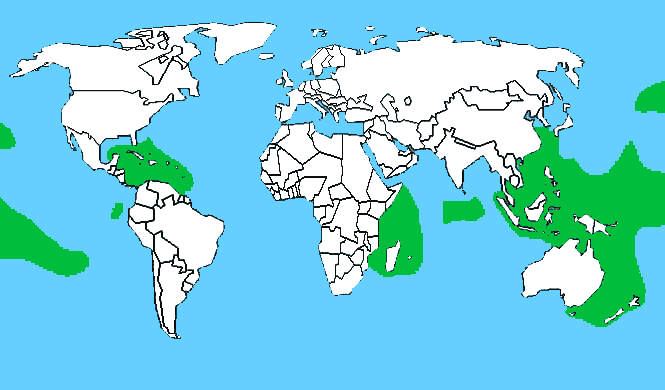

- “There is a risk in all warm seas and oceans of 20°C and above, between 30° north latitude and 30° south latitude, especially when coral reef areas are nearby (though note that some fish sometimes migrate over very long distances).
- High-frequency zones: see map above.
- There appears to be a steady global increase worldwide.
Clinical Presentation of Ciguatera
Symptoms begin 1 to 6 hours after ingestion of contaminated fish (extremes: 10 min–36 h).
The clinical picture is evolving, varied, and polymorphic, combining in different ways three main syndromes and general manifestations.
- Digestive syndrome: nausea, vomiting, diffuse abdominal pain, diarrhea (most often watery), sometimes leading to acute dehydration, tenesmus, hiccups.
- Neurological syndrome (95% of cases): paresthesias, dysesthesias and hot/cold reversal, hyperesthesias, arthro-myalgias, gingival and dental pain, vertigo, paresis, paralysis.
- Cerebellar syndrome: cerebellar ataxia may be observed with coordination and balance disorders.
- Chronic fatigue: asthenia, lethargy, sleep disturbances with nightmares, early awakening, exercise intolerance, lack of motivation, various pains, daily headaches, etc. This syndrome may be linked to dysfunctions affecting the entire nervous system or to an associated depressive state. Its severity is not correlated with the type or severity of the intoxication.
- Depressive syndrome: it is unclear whether this depression is due to the toxin itself, secondary to the acute phase of intoxication, or to the persistence of chronic symptoms.
- Visual or auditory hallucinations: significantly more frequent in the Indian Ocean.
- Headaches, vertigo, dizziness, etc.
- Cognitive and psychological functions: do not appear to be affected.
- Cardiovascular syndrome: bradycardia, arterial hypotension.
- Sinus bradycardia below 60 bpm
- Arterial hypotension
- Orthostatic hypotension, which may persist for up to four weeks
- Much more rarely, hypertension, tachycardia, muffled heart sounds, rhythm disorders such as ventricular or supraventricular extrasystoles, bradyarrhythmias, first-degree atrioventricular block may be observed. In severe cases, cardiocirculatory failure may lead to shock, potentially worsened by acute dehydration.
- General manifestations: hypersalivation or dry mouth (early), pruritus (50%), sweating, chills, oliguria, dehydration, asthenia; erythema (delayed: day 2).
- Myalgias: especially large muscle groups. Two cases of polymyositis have been described in the U.S. in patients intoxicated by ciguatera years earlier.
- Arthralgias: mainly large joints, particularly knees, ankles, shoulders, and elbows.
- Pruritus: one of the hallmark symptoms of ciguatera, to the point of giving its name to the disease in New Caledonia. The palms and soles are most commonly affected. Pruritus may sometimes be generalized, notably after alcohol ingestion or significant physical exertion, i.e., when cutaneous blood flow increases. Itching can be severe, leading to scratch lesions with complications: excoriations, abscesses, cellulitis, scars, lichenification.
- Skin eruptions: nonspecific erythematous-papular lesions, sometimes with desquamation during recovery.
- Chills, shivering without fever.
- Hyperhidrosis, hypersalivation, hyperlacrimation, rhinorrhea.
- Neck stiffness.
- Dysuria, acute urinary retention.
- Metallic taste, dental pain, sensation of loosening teeth, gingival pain.
- Hydrophobia.
- Asthma-like dyspnea.
- Visual blurring or transient vision loss, ophthalmoplegia, diplopia, retro-ocular pain, conjunctival injection, photophobia, mydriasis or miosis, ptosis.
- Genital symptoms:
- Vulvar pruritus, dyspareunia (in some women, chronic symptoms worsen during menstruation).
- Penile pain during erection, intensifying at ejaculation, sometimes preventing sexual intercourse for weeks. Testicular pain, urethritis with meatal sensitivity.
- Mortality: varies according to studies and countries: 0.1–2%. Elsewhere, spontaneous recovery in one to several weeks.
Diagnosis of Ciguatera
- Based on recent consumption of fish in inter- or subtropical regions.
- Frequent clustered cases.
- Diagnosis is exclusively clinical, as no paraclinical test is available to date.
Treatment of Ciguatera
No specific antidote exists: treatment is purely symptomatic, as needed:
- management of cardiovascular collapse, respiratory arrest
- hydroelectrolytic resuscitation
- atropine in case of bradycardia
- antihistamines for pruritus (inconsistently effective, even disputed)
- avoid alcoholic beverages
- vitamin B therapy or placebo
Prevention of Ciguatera
Either avoid all fish consumption in risk areas, or restrict intake to small herbivorous fish; otherwise, risk reduction may be attempted considering:
Risk increases with fish that are:
- larger
- older
- uglier
- more carnivorous
- High-risk species include: barracuda, triggerfish, grouper, mullet, parrotfish, surgeonfish, shark.
- Eat fish only if formally identified as non-ciguateric by local fishermen, restaurateurs, or consumers (although such expertise has sometimes proven unreliable in recent reports).
- Popular test (unreliable, unverified scientifically, and ethically questionable): feed a portion of the fish to a domestic animal (dog, cat, chicken) and wait for possible symptoms.
In all cases, never eat the viscera, liver, or head of fish in risk areas.
Finally, note that cooking does not reduce risk, as the toxins are thermostable.
FAQ: Everything You Need to Know About Ciguatera in Sailing
- What is ciguatera and why is it a risk for sailors?
Ciguatera is a foodborne illness caused by consuming certain reef fish that have accumulated toxins produced by a micro-algae. For sailors, it is a major risk during cruises in tropical areas, as the intoxication can be debilitating at sea and may affect several crew members at once. - Which maritime areas are most at risk?
The risk is primarily concentrated in tropical and subtropical waters. The areas most closely monitored by sailors are the Caribbean, the Indian Ocean, and the South Pacific. Rising sea temperatures are expanding these zones, making vigilance necessary even in areas previously considered safe. - Which types of fish should be avoided when fishing or eating on board?
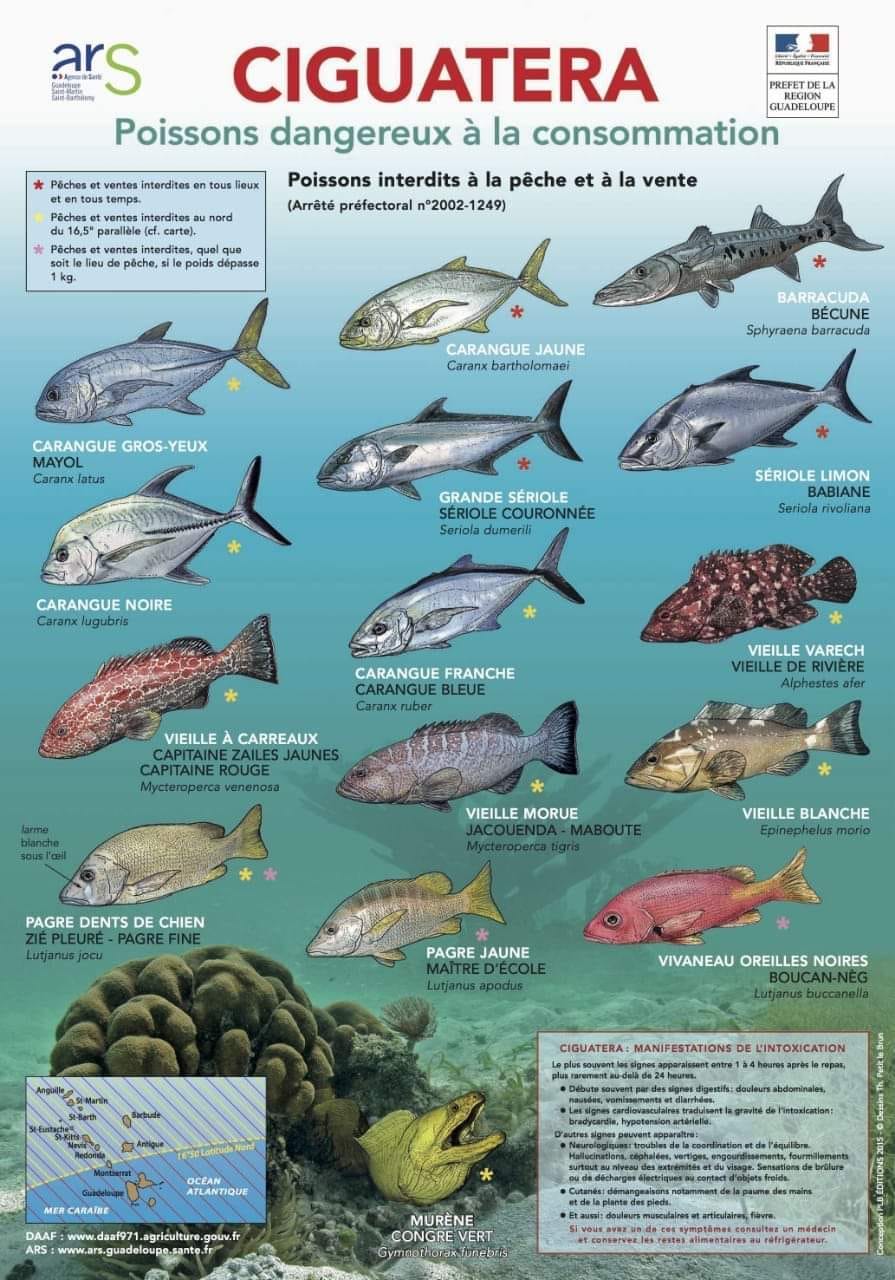
Carnivorous fish at the top of the food chain are the most dangerous because they concentrate the toxin. Skippers should be especially cautious with barracuda (often prohibited for consumption), groupers, jacks, snappers, and moray eels. In general, the older and larger the fish, the higher the risk. - What are the characteristic symptoms of intoxication?
Ciguatera manifests with digestive issues (nausea, pain) but is primarily recognized by neurological signs such as intense itching (the “prickling” sensation) and temperature reversal (cold water feels hot or burning). Symptoms can appear a few hours after eating. - How can risks be minimized during a stopover or crossing?
The golden rule is to seek advice from local fishermen who know the areas and safe species well. It is also recommended not to consume the head, eggs, or liver of reef fish, where the toxin is most concentrated. Currently, there is no simple or reliable test to detect the toxin on board before consumption. - Which onboard reference can be used in case of suspected intoxication?
If symptoms appear at sea, it is essential to consult the Onboard Medical Guide or Medicine and Safety at Sea. These references, available at the Nautic Way bookstore, detail first aid protocols and procedures for contacting Maritime Assistance and Medical Consultation centers (TMAS).